
Publish Date: June 17, 2026
Executive Overview
The modernization of enterprise data infrastructure is increasingly hindered by the persistence of operational silos within legacy data centers. In contemporary corporate environments, database engines—including Oracle Database, Microsoft SQL Server, PostgreSQL, and MySQL—frequently run on fragmented, dedicated physical hardware or disconnected virtualization clusters. This structural isolation is often driven by a historical need to guarantee maximum performance predictability and avoid resource contention. However, this model introduces substantial inefficiencies, creating heavy administrative overhead, fragmenting backup and security workflows, and multiplying software licensing costs. As data sets expand, managing these disconnected database islands through disparate manual routines limits business agility and obscures operational visibility.
To resolve these challenges and establish a unified data platform, the latest enhancements to the VMware Cloud Foundation (VCF) ecosystem focus on Consolidating Database Management. This updated model leverages VCF Data Services Manager (DSM) alongside automated SDDC Manager infrastructure orchestration to bring diverse database engines under a single control plane. By integrating database provisioning, configuration, scaling, and lifecycle operations directly into the private cloud hypervisor layer, VCF eliminates the friction between infrastructure administrators and database management teams. This enterprise advisory provides a technical analysis of the architectural mechanisms, quantifiable benefits, production deployment scenarios, and structural risks associated with consolidating enterprise database fleets onto a unified private cloud platform.
Features
Modern enterprise data consolidation requires an operational framework capable of managing diverse database engines while maintaining strict resource boundaries, automated high-availability protection, and consistent security policies. VCF achieves this by integrating VCF Data Services Manager (DSM) directly into the vSphere and vSAN storage architectures, transforming standard hypervisor nodes into intelligent, database-aware infrastructure platforms.
The foundational component of this consolidated framework is the Automated Provisioning and Fleet Management engine. Historically, requesting a new database required a database administrator (DBA) to manually configure an operating system, map storage volumes, adjust kernel parameters, and install the database software. Under the modernized VCF architecture, the platform exposes a standardized, API-driven self-service catalog. When a tenant requests a new database instance (whether an open-source PostgreSQL engine or a proprietary enterprise database), the platform dynamically pulls a verified, hardened template from a centralized registry. It automatically configures optimal compute allocations, structures optimized local storage policies, and provisions the engine with pre-tuned operational variables tailored to the specific database type.
The core architecture utilizes three primary integration layers to manage the database fleet:
- Storage Policy-Driven Ingestion: VCF leverages vSAN Express Storage Architecture (ESA) to map database workloads to specific performance profiles. Databases are automatically assigned to storage policies that optimize block sizes, enforce data-at-rest encryption, and configure write-buffer allocations appropriate for intensive transactional processing (OLTP) or analytical querying (OLAP).
- Consolidated Lifecycle Management: The VCF platform coordinates software patching, minor version upgrades, and security definitions through an automated, policy-driven pipeline. Administrators define allowed maintenance windows, and the system executes sequential rolling updates across database clusters, applying critical software patches without causing service downtime.
- Integrated Data Protection and Backup Orchestration: Data Services Manager abstracts backup routines by linking directly with enterprise local or cloud-based object storage targets. The framework orchestrates automated point-in-time recovery (PITR) logs and immutable snapshots, ensuring that database backups are kept synchronized and protected against unauthorized modification or ransomware encryption.
The management portal enforces a strict separation of operational concerns, dividing responsibilities into distinct control tracks:
- Cloud Provider Controls: Infrastructure engineers establish the underlying hardware resource pools, define maximum consumption quotas, manage storage profiles, and publish authorized database templates.
- Database Consumer Controls: Application developers and data science teams utilize clean REST APIs or a self-service console to spin up databases, configure access users, adjust performance scaling variables, and trigger manual snapshot captures independently of the infrastructure team.
Benefits
Consolidating disparate database silos onto a unified VMware Cloud Foundation platform delivers substantial financial, operational, and architectural advantages for enterprise private clouds. By standardizing database infrastructure on a software-defined control plane, organizations can reclaim valuable compute capacity and improve service availability.
The most prominent benefit is the significant reduction in per-core software licensing expenditures. High-value enterprise database engines are typically licensed based on the number of physical CPU cores or sockets present on the hosting hardware. In a siloed environment, low server utilization often leads to organizations paying for expensive database licenses on hosts that spend most of their time idle. By consolidating these isolated workloads onto dense, high-performance VCF clusters governed by strict compute policies and automated vSphere resource pools, architects can maximize CPU core density. This consolidation allows organizations to run significantly more database transactions on fewer physical cores, reducing license requirements and saving substantial amounts in recurring software maintenance fees.
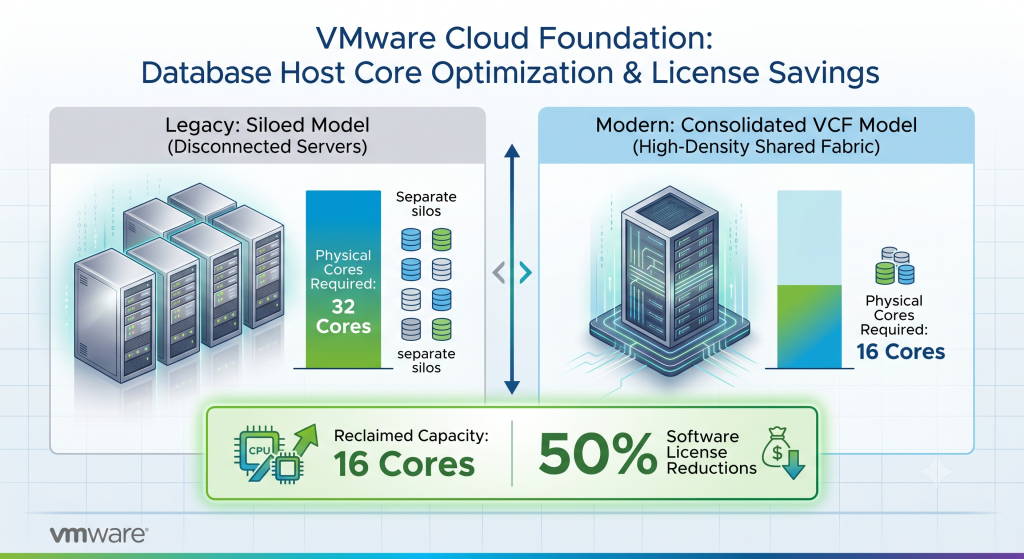
From an operational perspective, the platform eliminates the manual work and time-consuming ticket queues that slow down application deployment cycles. Traditional manual provisioning methods can delay database availability by days or weeks, stalling critical development sprints. With VCF Data Services Manager active, database provisioning is fully automated and completed in minutes. This rapid delivery enables application teams to build and test software faster, matching the operational agility of public cloud environments while keeping proprietary corporate data secure within the private data center.
Additionally, the consolidated architecture strengthens security posture and governance across the entire data estate. Managing independent database instances manually often results in configuration drift, missed security patches, and inconsistent access policies, leaving the data vulnerable to exploitation. VCF automatically enforces standard, pre-hardened operating system baselines, synchronizes access control policies with corporate identity systems, and ensures consistent encryption across all databases. This systematic enforcement simplifies regulatory compliance audits (such as GDPR or PCI-DSS) by providing a centralized dashboard to track and verify security compliance.
Use cases
To fully understand the practical value of consolidating database management within VCF, it is valuable to examine specific deployment scenarios across various enterprise environments.
The first major use case is Enterprise Database Infrastructure Modernization in E-Commerce Platforms. A large multinational retail corporation operates multiple individual database clusters to handle customer shopping carts, user authentication, inventory tracking, and sales analytics:
- The infrastructure team configures a high-density VCF cluster utilizing vSAN ESA storage optimized for high write-throughput.
- Using Data Services Manager, the team consolidates independent SQL and NoSQL instances onto the shared fabric, organizing them into isolated network zones via NSX VPCs.
- Transactional shopping databases are assigned strict performance profiles to ensure sub-millisecond checkout times, while analytics instances are configured to leverage lower-priority compute pools.
- The unified platform automatically handles heavy traffic surges during major shopping holidays by dynamically reallocating resource groups, preventing database crashes and ensuring continuous site availability.
The second use case focuses on Automating DevSecOps Software Engineering Pipelines. A major software-as-a-service (SaaS) provider requires hundreds of temporary database instances every day to run automated integration testing, code validation, and security scans for their development teams:
- The platform engineering team integrates the VCF Data Services Manager APIs directly into their central continuous integration/continuous deployment (CI/CD) pipelines.
- When a developer submits a code update, the automated pipeline triggers a declarative API request to VCF, instantly spinning up a fresh, isolated PostgreSQL database instance.
- The automated software tests run against the newly provisioned database, validating schema modifications and application code integrity.
- Once the tests complete successfully, the pipeline issues a teardown command, immediately deleting the temporary database and releasing all compute and storage allocations back to the main resource pool, eliminating infrastructure sprawl.
The third use case centers on Consolidated Compliance and Lifecycle Automation in Healthcare Networks. A national healthcare system manages medical records, patient check-in portals, and pharmaceutical inventory tracking software across dozens of regional medical facilities:
- Historically, patching these independent databases required coordinating multiple disconnected maintenance windows, often resulting in delayed security patches and compliance vulnerabilities.
- The organization deploys VCF to centralize database fleet management under a single administrative pane.
- The IT director establishes automated, rolling update policies within Data Services Manager for the entire PostgreSQL and MySQL fleet.
- The upgrade engine automatically handles database replication, shifting active connections to failover nodes while applying critical security patches to individual database hosts sequentially, ensuring continuous system uptime for medical staff and maintaining absolute regulatory compliance.
Alternatives
An objective architectural evaluation of VMware Cloud Foundation’s consolidated database management model requires comparing it to alternative database hosting designs and delivery methodologies.
- Dedicated Bare-Metal Hardware Deployments: In this traditional deployment model, each primary database engine is installed directly onto a dedicated physical server without a hypervisor layer. While this alternative eliminates virtualization overhead and guarantees that a single application has exclusive access to the physical hardware, it introduces massive operational inefficiencies. Bare-metal environments are highly prone to resource underutilization, require manual, complex high-availability scripting, and present a significant operational burden during hardware upgrades, creating rigid infrastructure silos that slow down application deployment timelines.
- Traditional Virtual Machines with Manual Database Installations: Under this architecture, databases are installed manually inside standard virtual machines running on generic virtualization clusters. While this leverages basic hypervisor efficiencies and enables workload mobility via live migrations, it lacks unified database lifecycle intelligence. Database administrators must still manually manage operating system updates, handle database patching, script high-availability failovers, and tune storage configurations for each virtual machine independently, leading to potential configuration drift and significant administrative overhead at scale.
- Public Cloud Managed Database Services (such as AWS RDS or Azure SQL Database): This alternative leverages fully managed, cloud-native database platforms where the cloud provider completely abstracts hardware management, patching, and scaling operations through a subscription billing model. While this cloud-native approach offers an exceptional developer experience and eliminates on-premises operational overhead, it introduces significant long-term challenges for highly regulated enterprises. The ongoing transfer of data over external networks raises critical data sovereignty and security concerns, and the recurring subscription models can result in unpredictable, high costs as data volumes grow.
- Containerized Databases managed via Open-Source Kubernetes Operators: This model utilizes container technologies to package and run database engines inside a Kubernetes cluster, relying on custom software operators to manage backup and failover routines. While this approach offers excellent flexibility for microservices-based architectures and supports rapid scaling, it introduces substantial operational complexity. Managing persistent storage attachments, configuring low-latency cross-pod networking, and maintaining stable state coordination inside ephemeral containers require highly specialized platform engineering expertise, creating additional technical debt for traditional enterprise infrastructure teams.
Alternative perspective
While consolidating database management on VCF provides significant operational efficiency and cost-optimization benefits, a critical analysis of the architecture reveals several technical challenges, performance trade-offs, and administrative friction points that enterprise architects must carefully plan for.
A primary technical concern is the inherent performance overhead and potential resource contention introduced by running intensive, multi-tenant database workloads on a shared hypervisor and storage fabric. Databases are uniquely demanding, requiring simultaneous, high-volume performance across CPU processing, memory bandwidth, and storage input/output channels. If an organization consolidates multiple busy database engines onto the same physical ESXi hosts and vSAN storage pools without precise resource mapping, the workloads can compete for resources—a scenario often called the “noisy neighbor” effect. Intensive analytical queries on one tenant database can cause latency spikes and resource starvation for a critical transactional database on an adjacent node, potentially requiring strict, hardware-level isolation rules that can limit the efficiency gains of consolidation.
Another major operational risk centers on the creation of a massive, single point of failure within the enterprise data architecture. In a siloed model, an infrastructure failure or management plane corruption typically affects only a single physical server or a specific database instance. However, consolidating the entire database fleet under a single software-defined orchestrator like VCF Data Services Manager means that any significant management plane corruption, automated upgrade failure, or administrative credential compromise can disrupt the entire data estate simultaneously. Organizations must invest heavily in redundant management architectures, design air-gapped backup targets, and enforce strict, multi-factor authorization boundaries to mitigate the risk of widespread, systemic downtime.
Furthermore, consolidating database management onto an automated private cloud platform can trigger significant operational and organizational friction between traditional database administrators (DBAs) and infrastructure platform engineering teams. DBAs are historically accustomed to having complete, granular control over the underlying operating system kernel, localized storage mappings, and precise database configuration files to manually tune performance. Transitioning to an automated system where database environments are deployed using pre-packaged, standardized cloud templates can be viewed as a loss of control, potentially leading to internal resistance. Organizations must implement a collaborative platform-engineering model, ensuring that DBAs are actively involved in designing the automated templates and governance guardrails to guarantee long-term operational success.
Final thoughts
The consolidation of database management onto VMware Cloud Foundation represents an important milestone in the evolution of enterprise data center architectures. By successfully integrating database provisioning, configuration, and lifecycle automation directly into the software-defined private cloud layer, Broadcom has delivered an enterprise solution that breaks down historical operational silos. The ability to optimize expensive software licenses, automate complex patching routines, and provide developers with a self-service database catalog allows organizations to transform their data centers into agile, highly competitive platforms.
However, a successful database consolidation strategy relies on careful architectural planning, precise resource governance, and a clear understanding of application performance profiles. Enterprise architects must resist treating consolidation as a simple migration project; instead, it should be approached as a comprehensive operational transformation that addresses storage performance tuning, security isolation, and team collaboration. When implemented within a well-designed infrastructure framework, consolidated database management on VCF proves that private clouds can deliver the speed, agility, and efficiency required to sustain modern data workloads, establishing a secure and scalable foundation for the future of digital business.
Source
The primary source for this analysis is the official technical publication from the VMware Cloud Foundation Blog:
The End of Database Silos: Consolidating Database Management on VMware Cloud Foundation