
Publish Date: June 16, 2026
Executive Overview
The rapid integration of generative artificial intelligence and large language models into the enterprise software ecosystem has exposed critical limitations in first-generation platform engineering frameworks. Over the past several years, organizations invested heavily in Platform Engineering (1.0) to establish Internal Developer Platforms (IDPs). These early platforms successfully automated standard DevOps pipelines, streamlined container orchestration, and abstracted basic compute, storage, and networking resources for traditional, microservices-based application development. However, as the industry enters 2026, the unique operational, data path, and hardware requirements of modern AI workloads are overwhelming these traditional structures, creating a fresh wave of operational friction and specialized infrastructure silos.
To address these resource bottlenecks and prevent the re-emergence of isolated infrastructure footprints, the cloud-native ecosystem is transitioning toward Platform Engineering 2.0. This architectural shift focuses on expanding the Internal Developer Platform to ingest, automate, and govern cognitive infrastructure resources alongside standard application components. Co-engineered within the VMware Cloud Foundation (VCF) private cloud ecosystem, Platform Engineering 2.0 delivers automated virtual GPU (vGPU) partitioning, secure local model caching registries, and standardized inference endpoints as structured, API-driven platform services. This enterprise cloud advisory provides an objective technical analysis of the structural requirements, operational outcomes, production use cases, and strategic trade-offs associated with upgrading enterprise delivery platforms to the Platform Engineering 2.0 model.
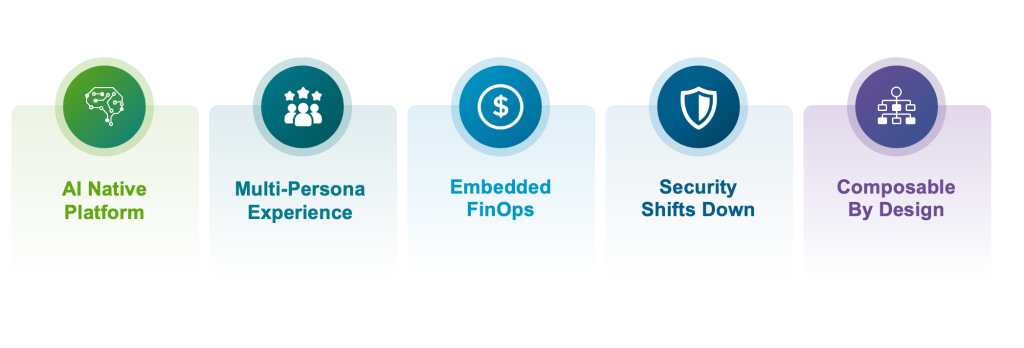
Features
Modern enterprise application delivery platforms must adapt to treat artificial intelligence runtimes and hardware accelerators as standard, programmatic resource objects. Platform Engineering 2.0 achieves this integration by expanding the declarative APIs of the underlying private cloud, enabling automated scheduling and isolation across both compute clusters and advanced deep learning fabrics.
The foundational architecture of Platform Engineering 2.0 centers on three core software-defined capabilities:
-
- Dynamic Hardware Accelerator Orchestration: In legacy platform models, provisioning graphics processing units (GPUs) required manual hardware passthrough configurations and specialized virtualization driver staging. Platform Engineering 2.0 integrates GPU allocation directly into the platform’s declarative automation layer. Through enhanced Kubernetes and Cluster API integrations within VCF, platform teams can expose specific virtual GPU (vGPU) configuration profiles directly to developers, allowing software teams to request precise fractional or full-frame GPU memory slices via standard application blueprints.
-
- Sovereign Model Registry and Weight Caching Pipelines: Large Language Models (LLMs) depend on massive, multi-gigabyte binary files containing neural network weights. Platform Engineering 2.0 incorporates secure, automated model management pipelines directly into the internal developer platform. When a data science team requests an optimized inference runtime, the platform automatically caches the certified model weights from secure local catalogs into the target workload domain, eliminating outbound WAN dependencies and securing intellectual property.
-
- High-Velocity Data Path Optimization: AI training and retrieval-augmented generation (RAG) architectures require massive, parallel data ingestion from enterprise storage arrays. Platform Engineering 2.0 leverages the performance enhancements of the Enhanced Data Path (EDP) Standard framework, using specialized fast-path memory architectures (such as DPDK-derived Mbufs) and Non-Uniform Memory Access (NUMA) node alignment to stream vectors and data structures to host memory channels at near-physical line rates.
Benefits
Transitioning to Platform Engineering 2.0 provides critical operational, financial, and competitive advantages for organizations scaling AI applications. By standardizing the cognitive infrastructure tier, enterprises can avoid platform fragmentation and eliminate manual engineering bottlenecks.
The most critical operational benefit is a dramatic improvement in developer velocity and time-to-market for intelligent software services. Under the previous platform iteration, software developers who wanted to build an AI-powered capability had to manually wait for infrastructure teams to wire up GPU nodes, configure deep learning dependencies, and set up isolated networks. This manual staging sequence often introduced weeks of delay. Platform Engineering 2.0 compresses this timeline to minutes by delivering pre-packaged, OpenAI-compliant REST inference microservices (such as NVIDIA NIM) directly through self-service developer portals, allowing application teams to consume AI models as a reliable, uniform utility.
From a financial and efficiency standpoint, the modernized platform architecture drives substantial optimization of capital investments in high-cost hardware accelerators. Physical GPU assets represent an immense financial commitment, and allowing them to run as isolated, low-utilization developer silos damages corporate efficiency. Platform Engineering 2.0’s dynamic vGPU partitioning allows platform teams to dynamically share, shift, and reallocate hardware resources across development, testing, and production environments based on real-time application demands. This high consolidation density maximizes hardware utilization rates, reducing infrastructure sprawl and driving down the total cost of ownership (TCO) of the data center estate.
Additionally, Platform Engineering 2.0 strengthens data governance and corporate security postures during the deployment of cognitive workloads. The platform establishes strict multi-tenant isolation guardrails by default, wrapping containerized inference engines inside secure software-defined network perimeters (such as NSX VPCs). This design ensures that proprietary enterprise knowledge bases, private customer interactions, and regulated transactional records are processed strictly within the secure boundaries of the private cloud, preventing data leakage to external, untrusted public model trainers and ensuring complete alignment with regional data privacy frameworks.
Use cases
To evaluate the operational impact of Platform Engineering 2.0, it is beneficial to explore specific production deployment scenarios across diverse enterprise IT environments.
The first major use case is the Automated Deployment of Secure Customer-Facing Generative AI Services. A global banking institution requires its platform engineering team to provide software developers with a standardized mechanism to deploy conversational virtual assistants capable of reviewing confidential customer financial records:
-
- The platform team builds an automated application blueprint within their Internal Developer Platform that combines a containerized front-end service with a localized inference microservice.
-
- When developers push a code change, the Platform Engineering 2.0 backend automatically provisions a secure network zone using NSX VPC abstractions.
-
- The system assigns a fractional vGPU profile to the inference engine to handle conversational requests and maps an encrypted vSAN storage path to host the localized customer database.
-
- The assistant is deployed and scaled automatically via self-service APIs, processing financial data securely within the bank’s sovereign private cloud boundaries.
The second use case focuses on Automated Continuous Integration Pipelines for Intelligent Applications. A major healthcare software vendor requires hundreds of daily test environments to validate machine learning models used to analyze radiology and diagnostic imagery:
-
- The platform engineers integrate Platform Engineering 2.0 APIs directly into their central GitLab and Jenkins CI/CD automation pipelines.
-
- During automated testing runs, the pipeline sends a single API call to spin up a temporary, CNCF-conformant Kubernetes cluster configured with dedicated GPU resources.
-
- The platform-native add-on manager automatically injects security certificates, monitoring agents, and the specified local medical model weights into the temporary namespace.
-
- The automated validation tests run quickly over high-speed, NUMA-aligned data paths, and once testing concludes, the system triggers an automated teardown to return the GPU capacity back to the shared corporate resource pool.
The third use case centers on Consolidating Distributed Industrial AI Inferencing at the Factory Edge. An automotive manufacturing enterprise operates multiple remote production facilities that utilize computer vision models to perform automated quality control and parts-defect detection on the assembly line:
-
- Managing independent, bare-metal AI computing nodes across multiple distant factory floors presents a severe configuration management challenge.
-
- The central platform engineering department deploys a uniform Platform Engineering 2.0 architecture managed remotely via SDDC Manager lifecycle orchestration.
-
- AI models are pushed as containerized microservices to localized edge clusters using automated, centralized template deployment rules.
-
- The edge nodes process low-latency vision analytics on the factory floor, and any performance metrics are piped back to the central console over secure channels, ensuring consistent manufacturing standards without local IT administrative overhead.
Alternatives
An architectural evaluation of Platform Engineering 2.0 requires contrasting its integrated private cloud approach against alternative methodologies for delivering enterprise AI infrastructure.
-
- Public Cloud AI Platform as a Service (PaaS) Frameworks (such as AWS SageMaker, Google Vertex AI, or Azure AI Studio): This alternative approach provides rapid access to high-performance AI infrastructure, automated model training loops, and managed inference APIs without requiring local hardware procurement. While this public cloud model minimizes initial operational complexity, it exposes highly regulated enterprises to continuous, unpredictable data egress fees and long-term financial liabilities under per-token billing models. Furthermore, transferring sensitive corporate records or intellectual property to external public providers creates significant data sovereignty and compliance risks that can complicate regulatory audits.
-
- Custom, Bare-Metal Linux and Open-Source AI Stacks: Under this infrastructure model, organizations bypass virtualization completely, installing Linux distributions directly onto raw server hardware and manually compiling GPU drivers, CUDA layers, and orchestration tools like Kubernetes and Kubeflow. While this bare-metal approach maximizes hardware performance by removing hypervisor virtualization overhead, it imposes an immense management burden on internal IT staff. The responsibility for maintaining complex driver-to-hardware compatibility matrices and custom automation code results in a brittle environment that is prone to severe configuration drift and slow environment provisioning speeds.
-
- Isolated, Single-Tenant AI Hardware Silos: This traditional approach involves purchasing dedicated physical appliance nodes pre-loaded with proprietary machine learning stacks for specific data science teams. While these appliances offer high out-of-the-box performance for compute-intensive training workloads, they function as isolated operational islands within the enterprise data center. They do not integrate with the organization’s existing software-defined networking, multi-tenant governance, or centralized backup frameworks, making it difficult to share hardware resources efficiently across other business divisions.
-
- Legacy Platform Engineering 1.0 Infrastructure Models: In this scenario, organizations attempt to force modern AI applications to run on their existing, unchanged developer platforms designed for traditional CPU-bound microservices. While this model requires zero initial software platform upgrades and leverages mature automation pipelines, it completely lacks the capability to govern, partition, and automate advanced cognitive hardware resources. Data science teams are forced to bypass the internal platform and submit manual tickets for GPU configuration, leading to a re-emergence of dark IT silos and slower development lifecycles across the enterprise.
Alternative perspective
While the transition to Platform Engineering 2.0 provides an effective mechanism to standardize and automate enterprise AI delivery, a critical analysis of the technology reveals substantial architectural risks, capacity demands, and operational dependencies that platform planners must carefully evaluate.
A primary technical concern is the severe resource contention and physical “noisy neighbor” effect that can occur when consolidating intensive AI inference pipelines onto a shared enterprise private cloud infrastructure. Deep learning workloads generate unique, sustained stresses across host CPU processing, memory bandwidth, and storage I/O channels that are fundamentally different from traditional, bursty web application traffic. If an organization combines these resource-heavy workloads onto the same physical ESXi nodes and vSAN storage clusters that host critical corporate database systems, an unexpected surge in AI inference requests can cause severe performance degradation for adjacent legacy workloads, potentially requiring strict physical cluster boundaries that limit the economic efficiencies promised by platform consolidation.
Another major operational risk is the acute lifecycle management mismatch between fast-evolving machine learning software and conservative infrastructure patching frameworks. The generative AI ecosystem moves at an extraordinary velocity, with open-source communities releasing new model architectures, specialized library modifications, and driver requirements almost weekly. Conversely, enterprise-grade private cloud platforms are managed with a priority on long-term stability and predictability, utilizing conservative, heavily tested upgrade baselines that occur on quarterly or bi-annual schedules. Bridging this operational disconnect represents a significant challenge; if a developer team requires an uncertified GPU driver or an advanced optimization tool that has not yet been validated by the central platform framework, the organization must choose between stalling developer innovation or introducing unvalidated components that could compromise platform stability.
Furthermore, the implementation of Platform Engineering 2.0 risks creating a significant “cognitive load overload” for the internal platform engineering staff. Managing a modernized internal developer platform requires expertise that spans traditional virtualization, software-defined leaf-spine networking, advanced storage policies, and container runtimes, while now adding complex deep learning components like vGPU operators, CUDA compilation layers, and vector databases. If an organization lacks cross-functional talent capable of navigating both the hypervisor layer and cloud-native machine learning architectures, diagnosing complex production failures can lead to prolonged resolution windows and internal friction between infrastructure, security, and data science teams, potentially slowing down the organizational agility the platform was designed to achieve.
Final thoughts
The evolution of application delivery frameworks toward Platform Engineering 2.0 represents a necessary structural response to the unique operational challenges of the generative artificial intelligence era. By expanding the internal developer platform to automate, govern, and deliver advanced cognitive infrastructure resources alongside standard application components, Broadcom’s co-engineered platform provides a clear path to eliminate operational silos and accelerate software deployment velocity. The ability to provide developers with secure, self-service access to high-performance inference microservices while maintaining strict multi-tenant governance allows organizations to transform their data centers into agile, highly competitive environments.
However, achieving long-term success under the Platform Engineering 2.0 model requires a disciplined strategy that extends beyond software deployment. Platform architects must approach this evolution with a holistic operational view, implementing strict resource isolation guardrails, establishing rigorous driver compatibility validation procedures, and investing heavily in cross-functional team enablement. When aligned with a mature cloud management strategy, Platform Engineering 2.0 proves that private cloud networks can deliver the velocity, performance, and uncompromised security required to sustain the next generation of intelligent enterprise applications, creating a secure and highly scalable foundation for the future of digital business.
Source
The primary source for this analysis is the official technical publication from the VMware Cloud Foundation Blog: